
At Parallel, we help medical information teams code their stays more accurately. Until now, our suggestions covered secondary diagnoses and procedures. Parallel now goes one step further: its AI can also determine the stay’s principal diagnosis.
Why Parallel’s AI now determines the principal diagnosis
A frequent request from medical information teams
This was one of the features that medical coders and Medical Information Department physicians asked us for most. Choosing the principal diagnosis is one of the trickiest calls in coding, and teams wanted a second pair of eyes there too.
An additional optimization lever
The principal diagnosis largely determines which major diagnostic category a stay falls into, and then its diagnosis-related group (DRG), which sets the reimbursement. A poorly chosen principal diagnosis skews the value of the stay, however well the secondary diagnoses are coded. Getting it right means both a more accurate record and a better-valued stay.
How it works
Parallel suggests changing the principal diagnosis in two situations:
- a secondary diagnosis already coded by your teams is a better fit as principal diagnosis;
- a secondary diagnosis suggested by Parallel is a better fit than the principal diagnosis in the discharge summary.
As with secondary diagnoses, we only suggest a change when it increases the stay’s reimbursement value AND the principal diagnosis can be justified in a few lines, with quotes from the patient record and the methodological guide.
The reference principal diagnosis always stays visible
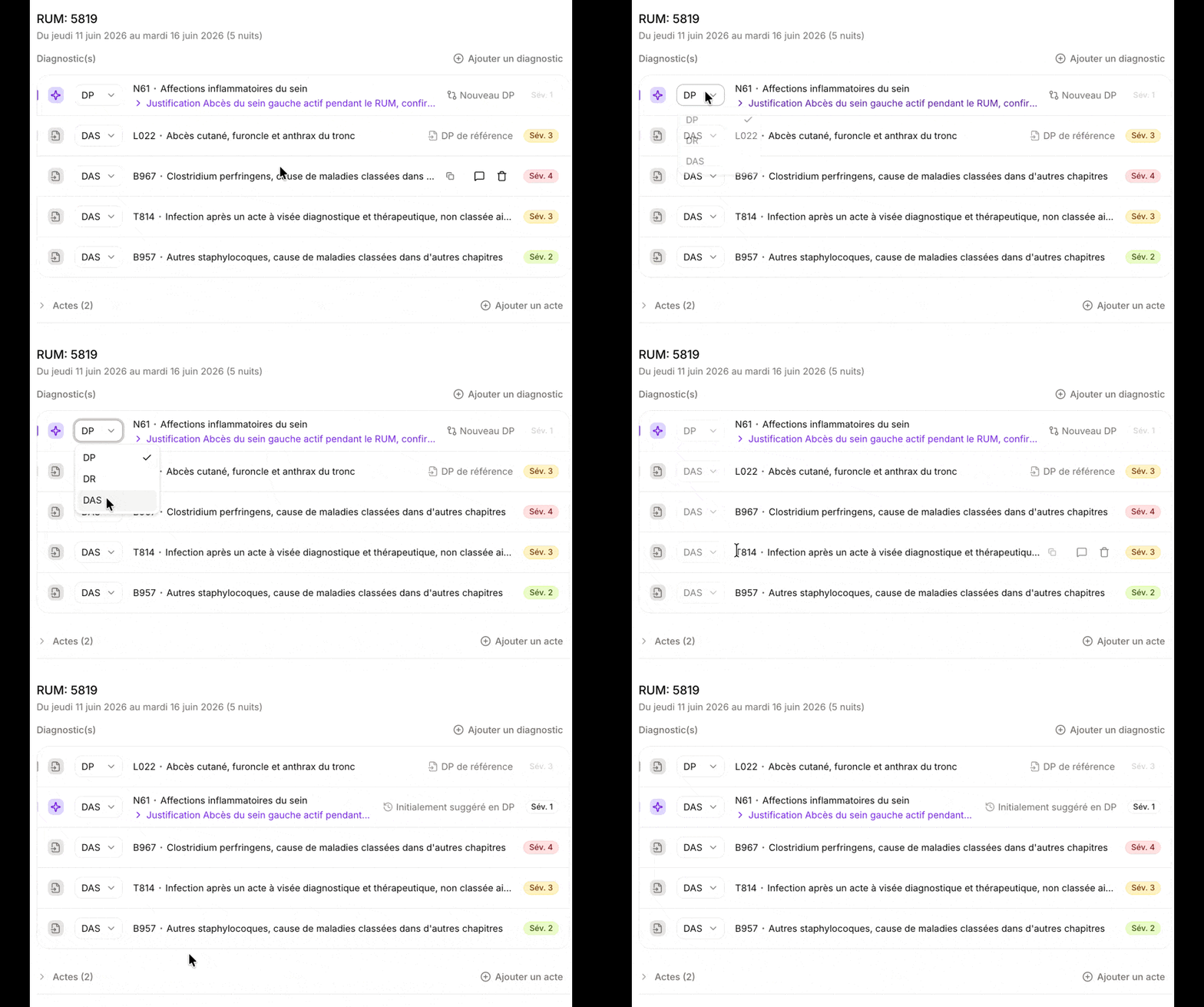
The suggested principal diagnosis appears at the top of the diagnosis list. The previous one remains visible as a secondary diagnosis, tagged “DP de référence” (reference principal diagnosis), so you always know what was originally coded. The suggested one is tagged “DAS suggéré en DP” when it was already coded as a secondary diagnosis, or “Nouveau DP” when it comes from a Parallel suggestion.

A dedicated justification, grounded in the official coding guide
Every suggested principal diagnosis comes with its own justification. It explains why this code better describes the care provided during the stay, cites the record excerpts it relies on, and quotes the applicable rule from the official methodological guide. For example: “Under rule T1, the underlying disease D46.9 is a better principal diagnosis than unspecified anemia D64.9.”
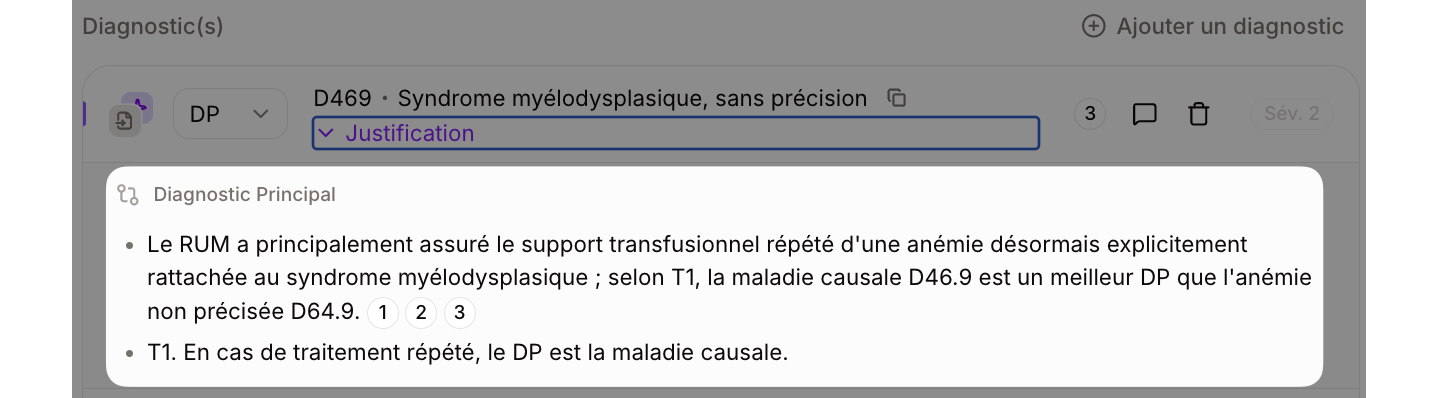
Two justifications when the principal diagnosis comes from a Parallel suggestion
When the suggested principal diagnosis is a secondary diagnosis suggested by Parallel, you get two levels of justification:
- first, the principal diagnosis justification, explaining why this code should become the principal diagnosis;
- then the usual justification for the code: the clinical summary, the record excerpts, the matching ICD-10 rule, and the codes considered and ruled out.

You stay in control
Your coders always have the final say. To reject a suggested principal diagnosis, simply switch it back to a secondary diagnosis using the DP/DAS selector. If it isn’t relevant at all, you can also delete it.
What’s next
Today, Parallel focuses its analysis on stays identified as having optimization potential. But a stay with no missing secondary diagnosis can still be under-valued if its principal diagnosis is wrong. This new feature will let us extend our analysis to stays Parallel did not cover until now.
It’s one more step toward our goal: supporting healthcare facilities on every type of stay.
This feature is already available in your Parallel app. Feel free to reach out to your account manager to learn more, or ask us your questions directly.