


The Parallel engine is evolving, here's what's changing.
Part 1 — What's new
An ICD-10 engine that's twice as accurate
We reworked the engine based on feedback from clinical coding teams. It gains in both precision and completeness:
Half as much noise, thanks to suggestions that better respect coding rules: medical history, official coding guidelines, and more.
Only the codes that genuinely affect the reimbursement value of the stay are suggested.
A new procedure coding engine
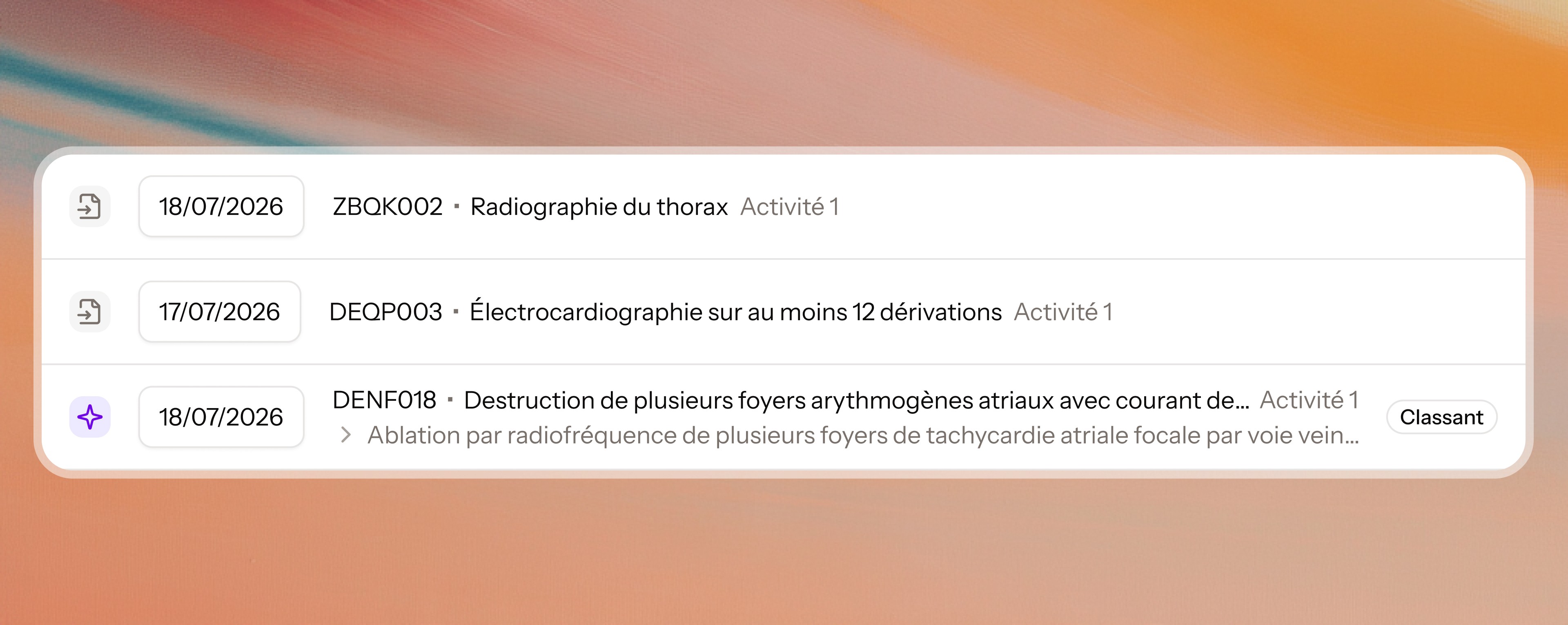
Parallel now suggests grouping-relevant procedures — those likely to change a stay's reimbursement value. This is a first on the French market, made possible by the capabilities of generative models:
Procedure suggestions appear directly in the Parallel interface.
It works the same way as for diagnoses: we only suggest procedures that increase the stay's reimbursement value, backed by rules and source citations.
The result: 10 to 30% additional revenue compared with ICD-10 optimization alone.
More complete justifications
Every suggestion now comes with everything you need to make a quick call on it:
A summary sentence explaining why the code was retained.
"Active acute hypercapnic respiratory failure on 3 December 2024, with distress, SpO2 at 89% on 4 L/min and PaCO2 at 64.9 mmHg, treated with non-invasive ventilation."
The exact excerpts from the patient record the suggestion is based on.
🆕 The corresponding ICD-10 or procedure coding rules, quoted directly.
🆕 The other codes that were considered and ruled out, so you can confirm the most precise code was the one retained.

Part 2 — What this means for your Parallel experience
Before rolling out this new engine, we tested it to assess whether it would improve your overall Parallel experience. Here are the results of the study we ran on several thousand stays:
Previous engine | New engine | Change | |
|---|---|---|---|
Optimization rate | 25% | 15% | −40% |
Average € per optimized stay | €2,500 | €2,600 | +4.0% |
Codes to review (on revalued stays) | 1,400 | 500 | 3× fewer |
Codes per optimized stay | 5 | 3 | 1.5× fewer |
What this changes in practice for your teams: 3× fewer codes to review, and more precise suggestions that are easy to adjudicate.
What's next
We're not stopping there. Our next projects:
Challenging the principal diagnosis: identifying even more revenue opportunities, with the same standard of justification.
Supplemental payments: reusing the same engine to catch missed marker procedures and automatically recalculate the SAPS II score.
Rehabilitation care optimization: a new product dedicated to post-acute and rehabilitation care, with the same effectiveness as Parallel for acute care, adapted to the length and complexity of those stays.
Feel free to reach out to your account manager to learn more, or ask us your questions directly.
" height="35.939368511864124px" id="XXgxUBGWM" width="132.67309544358307px"/></g></svg>)